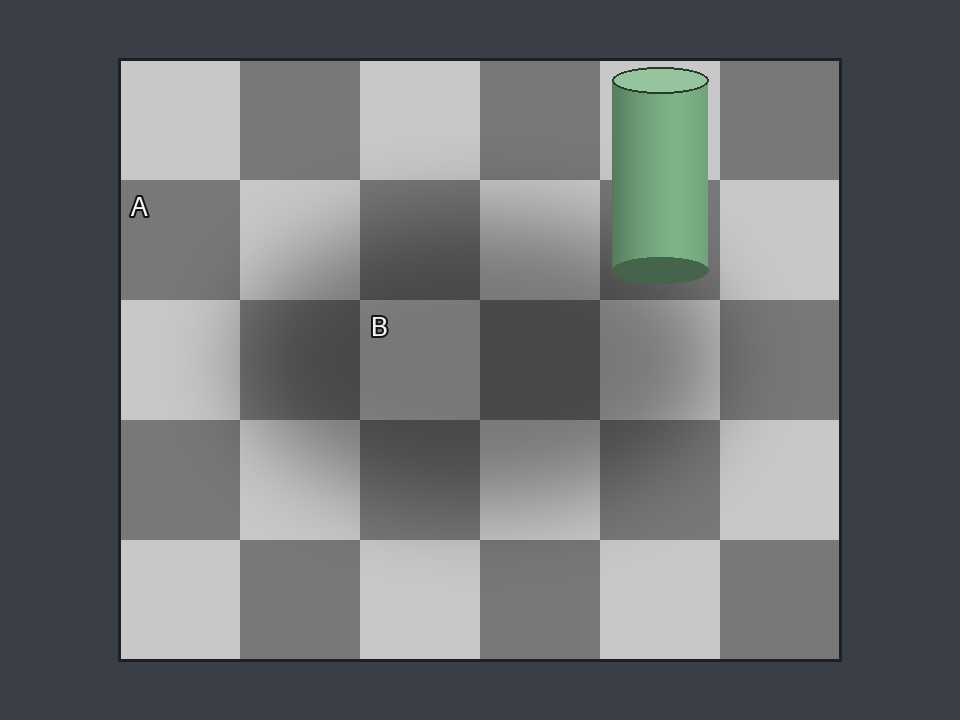
Are These Checker-Shadow Squares Really Different Shades?
A and B are pixel-identical; the difference is inferred, not sensed.
Precise claimIn Edward Adelson's checker-shadow image, the squares marked A and B are pixel-identical (sampled at RGB 120, 120, 120 in the published image). They appear to be different shades because the visual system estimates surface lightness by discounting the cast shadow and weighing local contrast, not by reporting luminance.
Applies
Applies to Adelson's published image and a faithful on-page reproduction sampled live. The mechanism — lightness inference through shadow discounting and local contrast — is documented by the image's creator and is consistent with retinex theory.
Does not prove
Does not claim that all perceived color differences are illusory, that vision is generally untrustworthy, or that the page diagnoses any individual's color perception.
Portable rule
If two colors must match across different lighting or backgrounds, then compare them isolated from context — masked or sampled — never by eye in place.
Declare the discussion context, then copy a stable link. No account or personal data is attached.
perceptual-inference
Are These Checker-Shadow Squares Really Different Shades?
Judge which checkerboard square is darker, then remove the surrounding context and inspect what the browser actually sampled.
Square A sits outside the shadow and reads as a dark check. Square B sits inside the shadow and reads as a light check. Judge the paint, not the story around it.
The reveal
In Edward Adelson's checker-shadow image, the squares marked A and B are pixel-identical (sampled at RGB 120, 120, 120 in the published image). They appear to be different shades because the visual system estimates surface lightness by discounting the cast shadow and weighing local contrast, not by reporting luminance.
You answered: —
This page just drew the rendered image into a canvas and read the actual pixels under each square — live, a moment ago, from the copy your browser painted:
Square Asampling…
Square Bsampling…
—
This browser session could not load or sample the proof image, so neither the numeric readout nor the live context bridge can run honestly here. Reload to retry, or inspect the cited source below.
Nothing changed on the board. What changed is what your visual system did with it: it discounted the cast shadow, read the soft edge, and weighed each square against its neighbors — then reported a surface difference that was never in the pixels.
Same paint. Different story.
The rebuilt model
You assumed:
My eyes report the actual light values: if square A looks darker than square B, then A's surface really is a darker gray.
The actual model:
Perceived lightness is an inference about surface reflectance: the visual system discounts the illuminant, reads shadow edges, and compares neighbors, so identical luminance can be reported as different shades.
The variable that failed you:
Surrounding context — the cast shadow and neighboring checks the visual system uses to discount illumination before reporting shade.
Change one variable
Same image, same squares, same pixels. The single thing that changes is the surrounding context — a uniform gray bridge, painted from the value this page sampled live, connects A and B.
Three-step reveal
Step 1 of 3: the full shadow context is still shaping the judgment.
ABSame sampled paint
The bridge is filled with the exact color the sampler read from both squares — not a prepared asset. Switch back to the full image and the difference revives; strip the context and align the pair to see it collapse.
The creator's statement that squares A and B are the same shade of gray, the proof-by-stripes demonstration, and the shadow-discounting and local-contrast explanation.
The theoretical basis that perceived lightness correlates with surface reflectance rather than incident light flux, grounding the shadow-discounting model.
paper — checked 2026-07-20.
Scope: Applies to Adelson's published image and a faithful on-page reproduction sampled live. The mechanism — lightness inference through shadow discounting and local contrast — is documented by the image's creator and is consistent with retinex theory.
Does not prove: Does not claim that all perceived color differences are illusory, that vision is generally untrustworthy, or that the page diagnoses any individual's color perception.
If two colors must match across different lighting or backgrounds, then compare them isolated from context — masked or sampled — never by eye in place.
Design review
Sample palette values or mask the component instead of judging a swatch against its themed background.
Photography
Set white balance from a neutral reference, not from how the scene feels — perception has already discounted the illuminant.
Print proofing
Judge color matches in a standard viewing booth; a proof that matches under one lighting context can fail under another.